Most body shape guides were written by Western brands, for Western bodies, using Western beauty standards as the measuring stick. They were not written for us.
African women's bodies are not a variation on a Western template. They are the original. This guide throws out the old rules and starts from a place of celebration: your body is the right body. The question is not how to minimise, conceal or "fix" anything. The question is how to dress in a way that makes you feel powerful, beautiful and entirely yourself.
A New Framework: Dressing for Feeling, Not for "Fixing"
The traditional body shape guides (apple, pear, hourglass, rectangle) were built on the idea that there is a "correct" shape and everyone else should use clothing to fake it. We reject this framework.
Our framework is different:
- Dress to feel confident. What makes you feel powerful when you walk into a room?
- Dress for your proportions. Not to change them, but to work with them — understanding which silhouettes create the visual balance you personally find pleasing.
- Dress for your actual life. Not for an imaginary occasion, but for Monday morning, Thursday evening, Saturday brunch.
Understanding Proportions (Without the Shame)
Proportions in dressing are not about hiding anything. They are about creating visual harmony — balance between different parts of your body that feels pleasing to you. Here are the principles:
If You Carry More Weight on the Bottom Half
Your hips and thighs are your foundation. Many of the world's most celebrated body shapes are built exactly this way — and for good reason. The clothes that work beautifully:
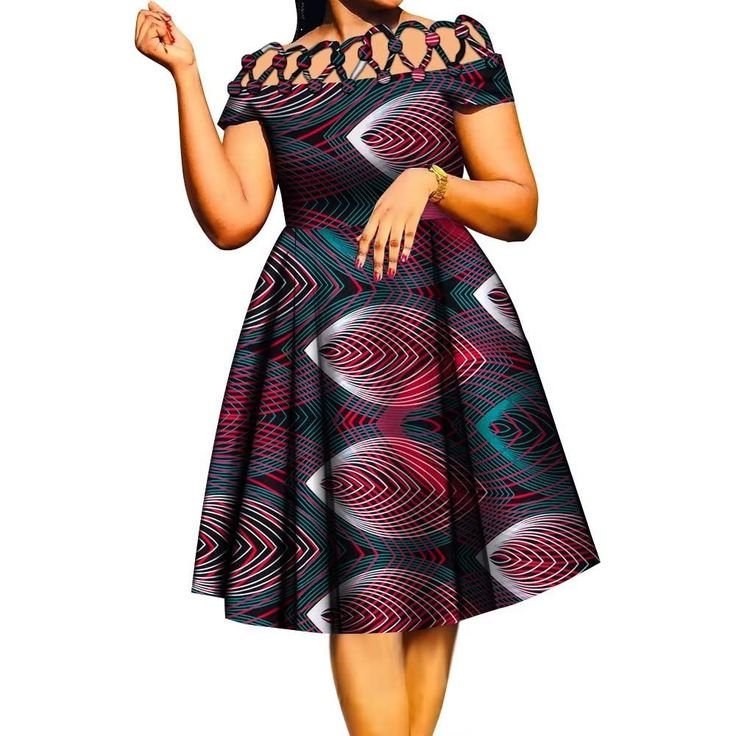
- A-line and fit-and-flare silhouettes: These follow the natural curve of your waist and then flow outward, creating a balanced line from waist to hem. A-line midi skirts are particularly flattering.
- Wrap dresses: The diagonal neckline of a wrap dress draws the eye upward and inward, while the fabric at the hip drapes rather than clings.
- High-waist everything: High-waist trousers and skirts with a tucked-in top elongate the torso and define the waist. This is a universally successful formula.
- Bold tops: A statement blouse, a structured blazer, a bright colour on top — these balance visual attention between upper and lower body.
Avoid with caution: Very tight bodycon skirts without the confidence to carry them (wear them if you love them — just know they emphasise rather than skim), and very full, gathered maxi skirts that add volume without structure.
If You Carry More Weight on the Upper Half
Broad shoulders, a fuller chest or a fuller upper back are common in many African women's builds and are entirely beautiful. Clothing strategies that work well:
- V-necks and scoop necks: These draw the eye vertically rather than horizontally across the chest, creating a lengthening effect.
- Vertical lines and seaming: Vertical details — seams, pleats, buttons down the front — draw the eye up and down rather than across.
- Wide-leg and flared trousers: A fuller trouser on the bottom balances a fuller top, creating proportion without requiring any concealment.
- A-line skirts and dresses from the waist: A nipped waist with volume below creates visual balance between a fuller top and the lower half.
If You Have a Straight or Athletic Build
What is sometimes called a "rectangular" body shape — fairly even measurements across bust, waist and hip — is an incredibly versatile starting point. Almost everything works. The strategies for creating more defined curves when you want them:
- Ruched fabrics: Ruching creates the illusion of curves through fabric gathering. A ruched midi skirt on a straighter frame creates beautiful visual movement.
- Belted waists: A belt or belted dress creates a defined waist where the silhouette does not already have one.
- Peplum details: A peplum top or dress adds hip emphasis without padding.
- Co-ord sets in bold colours or prints: When the top and bottom match, the eye reads the whole silhouette as one elegant line.
If You Have a Very Defined Hourglass Figure
Full bust, defined waist, full hips. The fashion industry was built around this shape, which means almost everything works — the challenge is often finding clothing that is made for this proportionality, since fast fashion tends to cut for a straighter figure.
- Fitted pieces with stretch: Garments with elastane (spandex) accommodate the difference between waist and hip measurements that straighter-cut clothing does not.
- Wrap dresses: The adjustable tie means it works for your waist-to-hip ratio rather than fighting it.
- Midi lengths: Midi skirts and dresses are particularly flattering because they skim the most defined parts of the silhouette.
- Avoid extremely boxy cuts: Very boxy, oversized pieces can obscure the waist definition that is your strongest visual asset.
Height Considerations for Kenyan Women
Kenya is home to some of the tallest and shortest women on the continent. Both need specific attention:
For Taller Women (5'8" / 172cm and above)
You have the advantage of carrying proportion beautifully. Midi lengths that stop at the knee on shorter women hit at mid-calf on you — excellent. Maxi dresses skim the floor rather than pool. Wide-leg trousers work spectacularly. The only real consideration: inseam length. Many standard-sized trousers will be too short — look for "tall" cuts or shop at boutiques that stock longer inseams.
For Petite Women (5'3" / 160cm and below)
The primary goal is elongation — making the visual line of your body appear longer. This means:
- High-waist everything (raises the apparent waist, elongates legs)
- Monochromatic dressing (one colour head-to-toe creates an unbroken line)
- Heel height when appropriate (even a modest 5cm block heel makes a meaningful visual difference)
- Avoid very long maxi lengths that break the body at an awkward point — or hem them
- Mini and midi lengths over maxi for most occasions
The One Rule That Overrides Everything
Wear what makes you feel good.
Every guideline above is a suggestion, not a rule. Fashion guidelines exist to serve you — not to constrain you. If bodycon dresses make you feel powerful, wear them regardless of what any guide says. If you love the look of a voluminous maxi skirt, no proportion theory should stop you.
The most stylish women in Nairobi are not the ones who follow rules. They are the ones who know themselves — their body, their taste, their confidence — and dress from that knowledge rather than from fear.
African women have been setting the standard for beauty and adornment for thousands of years. Your body is not a problem to be solved. It is the canvas. Dress it with intention, with joy and with the knowledge that every body is the right body for the clothes that make you feel like yourself.